
I pull search data a few times a year. Partly to check what we’re seeing on the phones against something outside my own head, partly because I’ve been wrong before about whether a busy stretch means anything.
This time I pulled everything — five years of Houston metro data for “house cleaning,” “maid service,” and “house cleaning near me,” at monthly, weekly and daily resolution — and then exported the raw numbers instead of squinting at the charts. Then I pulled the same three terms for Texas and for the United States, so I’d know whether anything I found was actually about Houston.
That last step was the important one. It killed my headline. What replaced it is more useful.
Houston house cleaning searches doubled — and so did everyone else’s
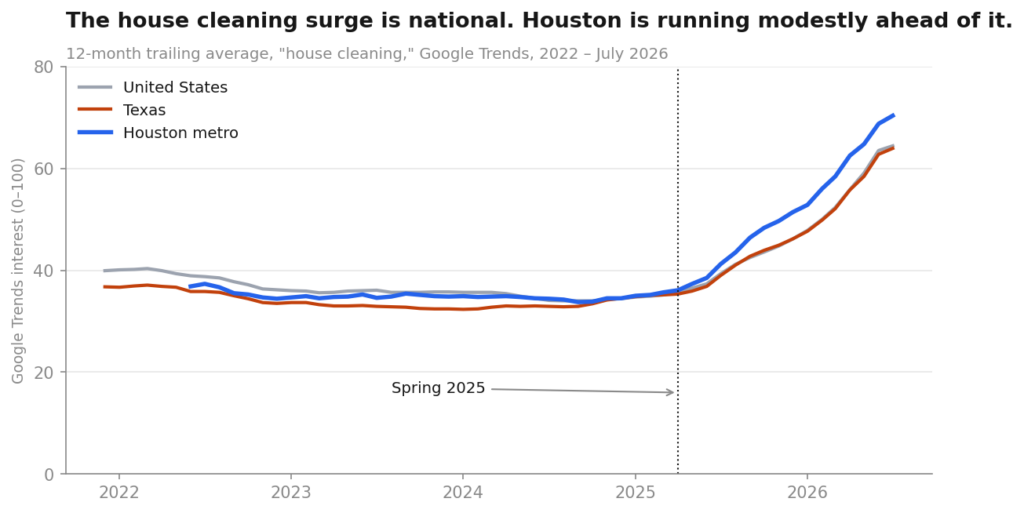
Here’s what I expected to find: Houston demand climbing while the country stayed flat, because Houston keeps adding people faster than anywhere else.
Here’s what’s actually there. From mid-2022 through February 2025, the twelve-month trailing average for “house cleaning” in Houston sat between 33.8 and 35.7. Thirty-two straight months inside a two-point band. Then it turns, and every month after is higher than the one before, ending at 70.2.
Texas does the same thing. The U.S. does the same thing. All three break out of their long flat stretch in spring 2025 — Texas first in March, Houston in May, the country in June — and all three roughly double over the following year.
Measured against its own 2022–2024 baseline, Houston is now running at 2.03×. Texas is at 1.91×. The U.S. is at 1.82×. Year over year, Houston is up 71% against 64% for both Texas and the country.
So Houston is ahead, and consistently so — the Houston index sat right around parity with the national number through 2024 and has run 10 to 20 percent above it since late 2025. But this is a national shift that Houston is participating in at a slightly higher temperature, not a local boom. Anyone selling you “Houston cleaning demand is exploding” without checking the national line is telling you something they haven’t verified.
A caveat I can’t fully resolve. A break that clean, arriving in three separate geographies within three months, makes me wonder whether Google changed how it samples this data rather than something changing in what people do. I can’t rule that out — Google doesn’t publish those changes. Two things make me think the underlying shift is real anyway. First, it’s a ramp rather than a step; the increase builds across eighteen months, where a measurement change would show up as one discrete jump. Second, and more convincingly, it didn’t lift all three search terms equally. That’s the next section
All three terms in one query, because that’s the only honest comparison
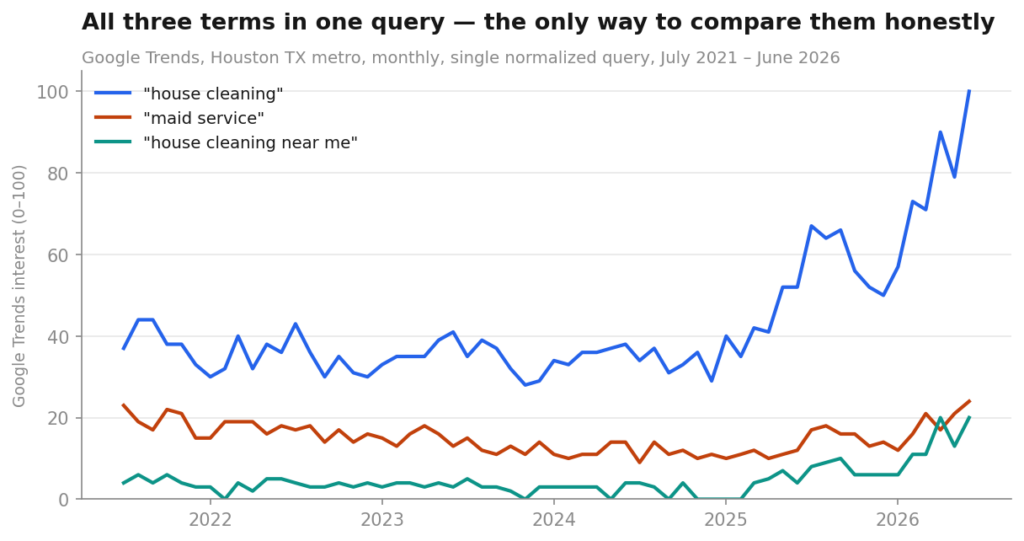
This is the mistake I nearly published.
If you download “house cleaning” and “maid service” as two separate Google Trends exports, each one gets scaled so that its own maximum equals 100. The two files cannot be compared. The numbers look comparable — same 0–100 range, same chart shape — and they mean nothing next to each other. I had a whole section written about relative volumes before I caught it.
The fix is to put all three terms into a single Trends query so they share one scale. Do that, and “house cleaning” is clearly the dominant phrase in Houston and has been the whole time, running at 62 to 73 percent of combined interest across the three terms every single year.
“Maid service” is losing, and Houston is losing it fastest
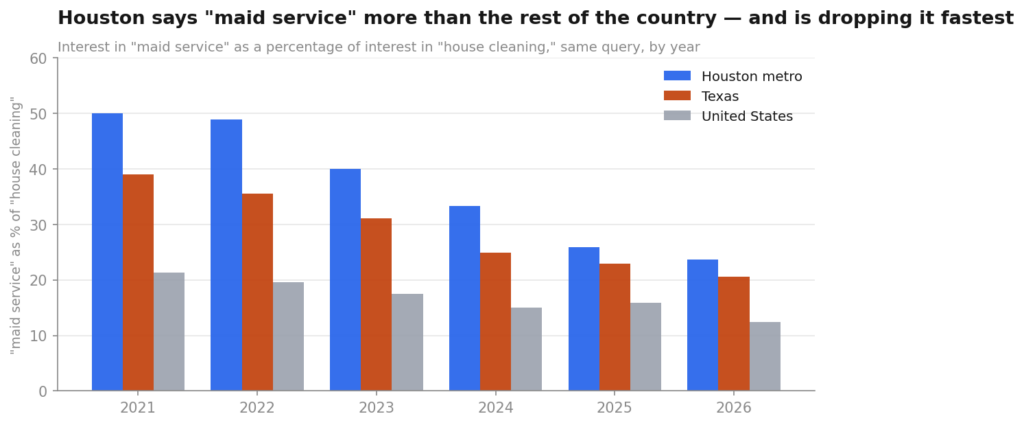
This is the finding I wasn’t looking for, and it’s the one I’d act on first.
In the same normalized query, “maid service” ran at about 50% the size of “house cleaning” in Houston in 2021. By 2026 it’s at 24%. The decline is relentless — 50.5, 48.8, 44.3, 39.9, 35.4, 33.3, 28.8, 25.9, 24.9 across successive twelve-month windows. Nine consecutive readings, every one lower than the last.
Two things make this more interesting once you add the national data.
Houston is unusually attached to the phrase. In 2021, “maid service” ran at 50% of “house cleaning” here, against 39% in Texas and just 21% nationally. Houston used that language more than twice as heavily as the rest of the country. Some of that is regional, some of it is presumably that a lot of long-established local companies have the word in their name.
And Houston is shedding it fastest. From 50 down to 24 here, against 39 to 21 in Texas and 21 to 12 nationally. Everyone’s dropping it. We’re dropping it from the highest starting point.
Now notice what that does to the methodology worry from earlier. “Maid service” grew about 46% over the past twelve months in all three geographies — real growth, but well behind the 64 to 71 percent for “house cleaning,” and it kept losing relative share straight through the spring 2025 inflection without flinching. A blanket change in how Google measures search would have lifted both terms together. It didn’t. Something genuinely changed about which words people reach for.
If you run a cleaning company here and “maid service” is the phrase on your homepage, your trucks and your title tags, that’s worth sitting with. We haven’t renamed anything. We have changed which phrase leads.
“House cleaning near me” is growing, with an asterisk
The near-me variant went the other way. In Houston it was about 10% the size of “house cleaning” in 2021, drifted down to 6% by late 2024, then reversed to 15% by mid-2026. Nationally the same reversal happens but more gently, from 10% to 14%.
The honest qualification: this term is small enough in Houston that individual months fell below Google’s reporting threshold and came back as zero — six of the fourteen months from January 2024 through February 2025. Growth measured off a floor like that overstates itself. Houston’s headline +274% year over year against +110% nationally is mostly that base effect, not Houston being three times hotter. The direction is real. The magnitude I hold loosely.
What I do take from it: the share of cleaning searches carrying explicit local intent is rising, in Houston and everywhere else. That’s a shift in how people search, and it favours whoever has their local listings in order.
Winter is the floor. Midsummer is the peak. Everywhere.
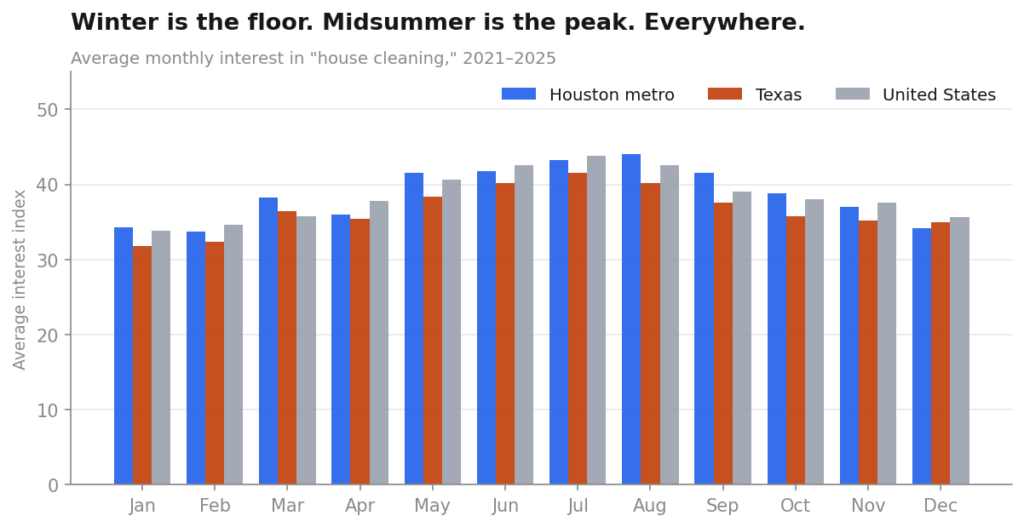
Five years of data, three geographies, same shape. Houston bottoms out in February at 33.8 with December and January essentially tied just above it, and peaks in August at 44.0 with July right behind. Texas troughs in January and peaks in July. The U.S. troughs in January and peaks in July.
I’m calling this out because it runs against a common assumption. The intuition is that people book cleaners for the holidays, so November and December should be the busy searching months. In five years of data across three geographies, the entire December–February stretch is the weakest part of the year and it isn’t close.
Our read: holiday cleaning is a decision households make in advance with a provider they already have, so it doesn’t generate a search. Summer searching is new-customer behaviour — people moving, hosting, or finally deciding they’re done doing it themselves.
That changes what you do about it. If winter is your slowest season for new inquiries but not necessarily for work, the answer isn’t to spend harder into a dead search market in December. It’s to have booked those December slots with existing customers in October.
Checking Google’s headline percentages against the raw exports
Trends now shows percentage badges above the chart. I wanted to know whether they hold up, so I recomputed them from the CSVs.
For “house cleaning,” Google reports the past month down 20% against the preceding month; I get down 23%. Google reports the past year up 80% over the preceding year; I get up 71%. Close enough to trust directionally.
For “maid service,” Google reports the past year up 90%. I get 46%. That gap isn’t Google being wrong — the badges are computed on actual search volume while I’m working from a normalized index, and at that term’s volume the index is coarse. Same lesson again: the lower the volume, the less any single number means.
The number I’d stand behind is the one that survives every method I tried. The past twelve months of “house cleaning” interest in Houston ran roughly 70% above the twelve months before it, and roughly 7 points ahead of the national figure.
Why any of this is happening
Search interest doesn’t move on its own. A few things line up:
Houston keeps adding people faster than anywhere else. The metro added 126,720 residents between July 2024 and July 2025, putting the population just above 7.9 million, up 1.6 percent, and that was the largest numeric gain of any U.S. metro area. Over a longer horizon, the region grew 39 percent between 2005 and 2025. That’s a constant flow of households who just moved and have no provider yet — and it’s a reasonable explanation for why Houston runs a few points hotter than the national line rather than tracking it exactly. InnovationMap + 2
Households are outsourcing chores they used to absorb. Industry research puts the share of dual-income households that regularly outsource cleaning at roughly 58%, and finds 62% of cleaning service bookings now happen through mobile apps and online platforms. That second number explains a lot about why search volume climbs faster than the number of cleaned homes. Demand isn’t only growing — it’s moving somewhere it becomes visible. Grand View ResearchGrand View Research
Labour is the constraint, not customers. BLS data for May 2025 counts about 860,670 maids and housekeeping cleaners nationally, with a mean hourly wage of $17.83 and a mean annual wage of $37,080. Wages in this occupation have climbed sharply. Anyone running a cleaning company right now knows finding work isn’t the hard part. U.S. Bureau of Labor Statistics
The gap I keep coming back to
Search interest is up roughly 70% year over year in Houston and roughly 64% nationally. National residential cleaning revenue is growing in the low single digits — IBISWorld puts the U.S. residential cleaning market at about $18.8 billion with a 3.2% five-year CAGR across roughly 357,000 businesses. IBISWorld
Those don’t contradict each other, but the gap between them is the whole point. Search growth that large against revenue growth that small says the market isn’t doubling. What’s doubling is the share of demand arriving through a search box instead of a neighbour’s recommendation.
That reframes the opportunity, and not in the flattering direction. The win here isn’t catching a wave of brand-new customers. It’s being findable when demand that already existed finally starts typing — which means the competition for visibility gets harder every quarter, because every operator in Houston is fishing in the same pond.
What we’re doing with this
- Leading with “house cleaning,” not “maid service.” Nine consecutive twelve-month windows of share loss is a trend, not a wobble — and Houston is shedding the phrase faster than anywhere.
- Not telling ourselves this is a Houston story. It’s a national shift we’re slightly ahead of. Planning as though we have a unique local tailwind would be planning on a number that isn’t there.
- Treating year over year as the only comparison worth acting on. Month-to-month moves in this data are noise unless they hold for a quarter.
- Booking December in October. If new-customer search collapses from December through February, the winter calendar has to be filled from the existing book.
- Ignoring daily charts entirely for anything but our top term. Now that I know how much of that data is threshold noise, I know what I was doing when I read meaning into it.
I’ll pull this again in six months. If the post-spring-2025 climb holds and Houston stays ahead of the national line, that’s worth planning around. If it flattens, that’s worth knowing too, and I’ll say so here.
If you made it this far: we’re always up for talking shop. If you run a cleaning company in Houston and you’re reading a different signal in your own numbers — especially if you think I’ve got the spring 2025 inflection wrong — call us. We’d rather compare notes than guess. And if you landed here because you’re actually looking for someone to clean your house, that’s easy too. Give us a call and we’ll tell you honestly whether we’re a fit.
All search data from Google Trends, web search, pulled 26 July 2026. Houston TX metro, Texas, and United States. Cross-term comparisons use a single normalized query; separate exports are not comparable to one another.